What the gameplay trailer shows
The official gameplay trailer runs about five minutes and cuts between four kinds of space: a misty churchyard, birch forest, a concrete utility facility and an ornate candlelit parlour. It shows a handgun, a shotgun and a knife, locked doors, item prompts and creatures that close distance fast.
The official gameplay trailer runs 5 minutes 14 seconds. It is the single most informative thing the studio has released, because it is continuous first-person footage rather than a cut-down teaser, and because it shows the game's actual pace rather than its highlights.
What follows is a walkthrough of what appears on screen, in the order it appears, with the parts that matter for how the game plays. Timestamps are approximate and refer to the trailer itself.
0:00 to 1:00 — the seated figure
The trailer opens indoors, in a low room lit by something warm. A gaunt, robed figure sits at a table with objects laid out in front of it — small carved or ritual pieces, arranged rather than scattered. The camera holds long enough for you to read the arrangement.
Two things are established in that first minute. First, the game has people in it, or something that was people. Second, its horror vocabulary is ritual and folk practice rather than industrial accident. A table set out with objects is a deliberate act by someone.
The hold is long. This is not a trailer that cuts every two seconds, and that is a statement about the game's pacing: it expects you to look at things.
1:00 to 2:30 — the facility
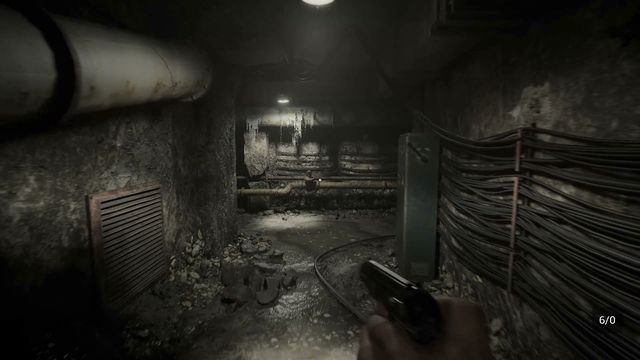
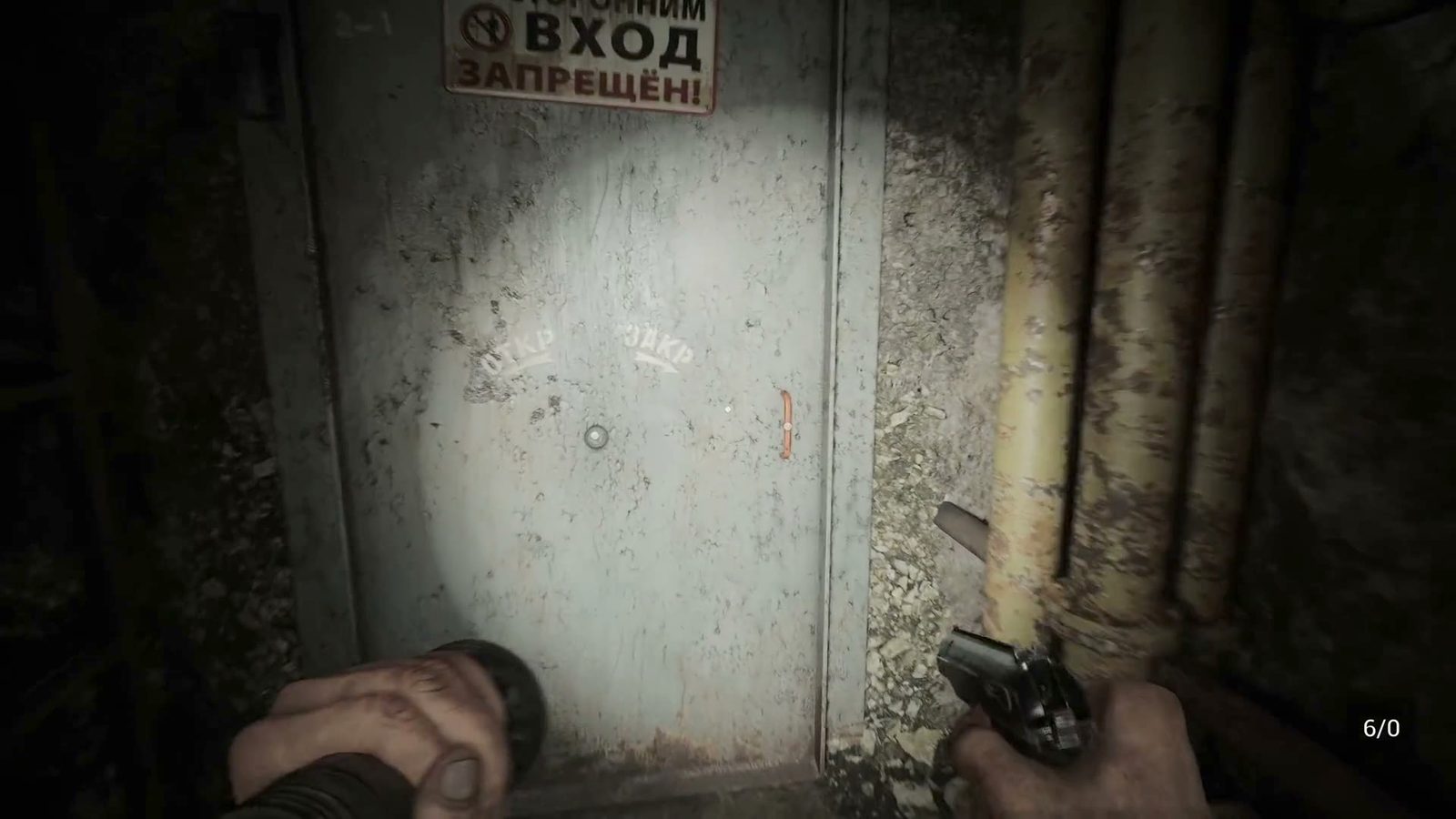
The middle of the trailer moves into concrete interiors: pipes running along ceilings and walls, wet floors reflecting a handheld light, barred windows, gates that are closed, doors with painted prohibition signage. A room behind bars contains a desk and equipment, viewed from outside.
This is the containment architecture the store description implies — observation, isolation, records. The lighting is almost entirely from whatever the player is carrying, which produces the specific effect the "absolute darkness" pillar is selling: you see a cone, not a room.
There are also item and interaction prompts on screen in this section, and at least one closed door marked as off-limits in painted lettering. Neither is elaborated on; both confirm that the game has pick-ups and gated routes.
2:30 to 4:00 — weapons and aftermath
The last third shows combat consequences rather than combat choreography. A handgun is in frame, a body lies on the floor, and in one shot a bloodied hammer rests in the foreground while the camera looks down at someone who is not moving.
This is a deliberate choice of shot. Instead of a montage of kills, the trailer shows you the position you will be in after the fight: standing over something, holding a light, deciding what to do next. That is consistent with a game whose stated advantage is gear choice and resource management rather than accuracy.
The weapons visible across the whole trailer are a handgun, a shotgun and a knife — exactly the three named on the store page. Nothing else appears in hand.
4:00 to 5:14 — the parlour and the closing
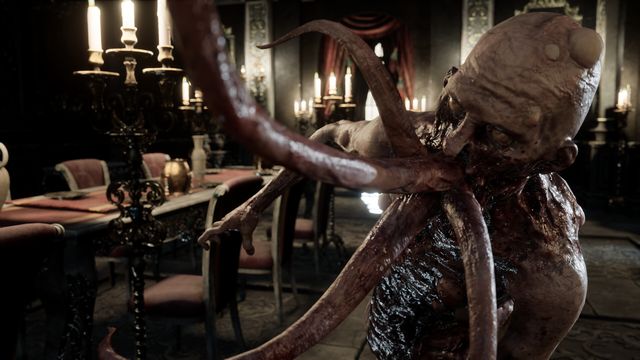
The final stretch returns to interiors with a different character: a room with a candelabra, framed paintings, heavy drapes and scarlet upholstery. It is the only space in the trailer that looks like it was built for people to enjoy rather than for a facility to function.
This is almost certainly the "blood-soaked ball" the store page names, and it works as a closing image because it breaks the visual grammar of everything before it. After four minutes of concrete and birch, red fabric and candles read as wealth, ceremony and a host.
The trailer ends without a title card promising a date.
What the footage confirms
| Claim | Evidence in the trailer |
|---|---|
| First-person, continuous | No cuts to third person, menus or maps at any point |
| Handheld light is central | Interior lighting comes from the player's own source throughout |
| Three weapons exist | Handgun, shotgun and knife appear in hand |
| Interaction prompts exist | Visible prompts on objects in the facility section |
| Locked and gated routes exist | Closed gates and a door with prohibition signage |
| Combat has aftermath | Bodies and bloodied weapons are shown, not just muzzle flashes |
| Environment changes rules | Tight corridors, open churchyard, dense forest, ornate interior |
| Ritual/folk imagery | Opening scene: a seated figure, objects arranged on a table |
What the footage does not show
This is as important as what it does show, because trailers are edited to hide weaknesses.
- No HUD tutorial, no objective list, no quest log appears on screen for more than a moment.
- No crafting, inventory or upgrade screen is shown at all.
- No death, no fail state, no game-over screen. The player is never seen losing.
- No named character is introduced, and nobody speaks on camera in a way that establishes a plot.
- No release date, price or platform appears on a card at the end.
If you are trying to work out whether the game is a systems-heavy survival game or an atmospheric walk with combat, the trailer argues for the first — but only the released build settles it.
How to watch it properly
Watch it once with sound, on headphones, and pay attention to what you can hear before you can see anything. In a game that sells silence and darkness, audio is the design. Watch it a second time with the sound off and count how many seconds pass between cuts; the answer tells you how the studio expects you to move through a room.
For how the combat spaces function, see Combat and weapons. For the setting the trailer is drawing on, Hellhole and the northern wilderness.